
Kelly Watt works on reality capture and digital twin programmes and led the operational digital twin work at Dallas Fort Worth airport. On 2DIAMR, Kelly Watt debated whether a 3D scan or mesh can be called a digital twin.
Episode
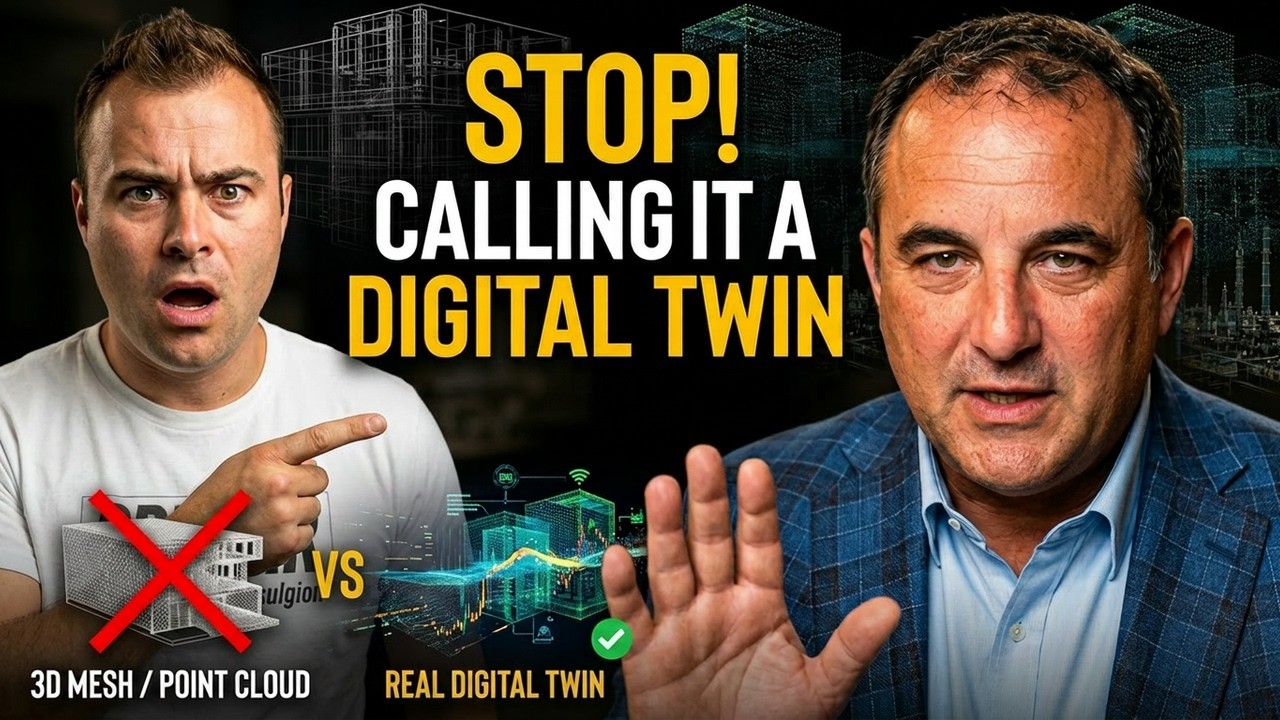 1 h 43 min
In Kelly’s words
“If it's a digital twin, one plus one can't equal two. It has to be a higher number.”
“I'm not emotionally attached to an instrument. I'm emotionally attached to solving the business problem first and foremost.”
“The nice thing about reality capture, it's a forensic capture in time. It's not interpreted.”
Quoted in our tech guides
Is a 3D scan a digital twin? What 9 practitioners say →
- “I'll agree to that. But I'll use them in my twin program. I had 1,400 Matterport files, projects that were tied to GIS and brought into the DFW project. So I think they're a component, but I don't think they're a twin on their own.”▶ 29:47
- “Do you call your bag of flour a digital twin?”▶ 30:50
- “If it's a digital twin, one plus one can't equal two. It has to be a higher number.”▶ 19:22
- “If you can't make a business use case, you have no business doing it.”▶ 15:15
- “Data goes to the graveyard after the project.”▶ 42:46
- “Do I think you have a digital twin without having any type of visual representation? Absolutely not.”▶ 27:17
Scan-to-BIM: from point cloud to Revit model – what 7 practitioners say →
- “A BIM model has got a human deciding what to model, what not to model, what to attribute, what not to attribute.”▶ 49:28
Questions Kelly answered
- What is the minimum needed before a point cloud or BIM model counts as a digital twin?
- Kelly Watt says the 3D data must be connected to other information – reality capture overlaid on the design model, attributed BIM tied to project management – so the combined data shows what the sources can’t show separately. ▶ 18:08
- Is a Matterport scan a digital twin?
- Not on its own, per Kelly Watt: a Matterport tour is a component. At Dallas Fort Worth airport, Kelly tied about 1,400 Matterport projects to GIS as part of the digital twin programme. ▶ 29:47
- What is a motional digital twin?
- Kelly Watt describes it as a digital twin that tracks the movement of people, vehicles or cargo in a 3D space for planning, forecasting and real-time response; at DFW’s Terminal D it draws on hundreds of installed solid-state LiDAR sensors. ▶ 92:24
- Why should reality capture be done during construction?
- Per Kelly Watt, it’s the cheapest moment to document what ends up behind walls, above ceilings, under slabs and underground; owners should require capture at key milestones and hand the data over to operations. ▶ 59:20
- Will robots replace laser scanning operators?
- Kelly Watt expects much more data to be captured but no fewer people: robots take over repetitive tasks, someone still has to set them up, manage them and govern the data, and the workforce shifts into different roles. ▶ 76:38
Talks about
Related guests
- Michael Schoelkopf – Director, Product Management Reality Capture, NavVis
- Barry Bassnett – Digital twin practitioner, author of Tower of Twins
- Povilas Sindriūnas – Business Developer, Undet
- Zlata Karpushina – Go-To-Market Strategist, FJ Dynamics
- Mehdi Boroumand – SLAM scanning practitioner, Australia
- Rami Tamimi – Geomatics project manager and Ph.D. candidate, WSP