
Guest on 2D Is Against My Religion
Michael Schoelkopf
Director, Product Management Reality Capture, NavVis
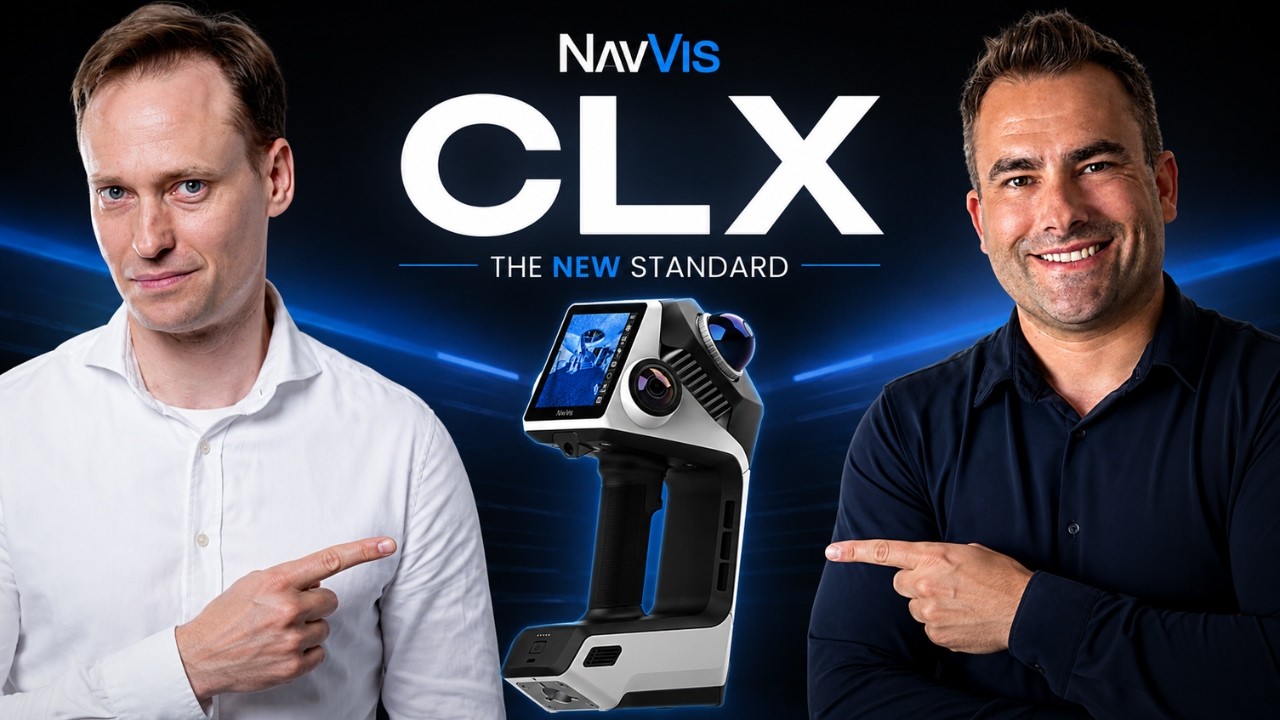
LinkedIn ↗Michael Schoelkopf leads product management for reality capture at NavVis. On 2DIAMR, Michael Schoelkopf explained what the handheld NavVis CLX SLAM scanner is built for – and the jobs it is the wrong tool for.
Episode
 55 min
In Michael’s words
“These floor plans obviously don't need an accuracy of five millimeters.”
“Even my mom could take this device and scan a hundred square meter apartment.”
“Never trust what somebody says about a product. Always look at the data.”
Quoted in our tech guides
Gaussian splatting vs photogrammetry: what 10 practitioners say →
- “You have the Gaussian splatting, but you measure on the point cloud.”▶ 39:21
Scan-to-BIM: from point cloud to Revit model – what 7 practitioners say →
- “So often reality capture is only the first step, but modeling on this data is something that takes much, much more time.”▶ 8:16
- “That is for LOD 300. For LOD 200 work, the CLX is the best device for that.”▶ 18:44
- “If you have multiple data sets, you will see because of a little bit of drift in both of them that you have double walls.”▶ 25:15
- “You can import the models back to IVION. You can see how model and reality compares.”▶ 8:25
Questions Michael answered
- Can NavVis CLX scans be combined with NavVis MLX or VLX data?
- Yes, per Michael Schoelkopf: all NavVis data can be combined in IVION, and a height overlap feature shows the best data in each area – so a quick CLX scan can be topped up with more accurate MLX data in specific locations. ▶ 16:53
- What is the minimum scanning distance of the NavVis CLX?
- Michael Schoelkopf says the Livox LiDAR spec sheet gives 10 centimetres, but near-range data is weaker, so stay at least 50–75 cm away; the best data comes from about one to five metres. ▶ 25:54
- How do SLAM laser scanners like the NavVis CLX handle mirrors?
- Per Michael Schoelkopf, mirrors remain a physics problem: the CLX uses the same 905 nm wavelength as the sensors in the NavVis MLX and VLX, and a mirror reflects the laser away, so there is no return to detect it. ▶ 26:46
- Does NavVis support Gaussian splatting?
- Michael Schoelkopf says Gaussian splatting is in beta for NavVis MLX customers, with CLX support planned by the end of 2026 (as of September 2026); the splats are for visualisation while measurements are taken on the point cloud. ▶ 38:38
- Can someone without surveying experience scan with a handheld SLAM scanner?
- Michael Schoelkopf says the NavVis CLX was designed so anyone can scan a 100 m² apartment, and loop closures are easy to understand – but experienced operators who learned from SLAM drift will still get better data. ▶ 48:08
Talks about
Related guests
- Zlata Karpushina – Go-To-Market Strategist, FJ Dynamics
- Mehdi Boroumand – SLAM scanning practitioner, Australia
- Dylan Gorman – Drone mapping, PilotByte Labs
- Rami Tamimi – Geomatics project manager and Ph.D. candidate, WSP
- Barry Bassnett – Digital twin practitioner, author of Tower of Twins
- Povilas Sindriūnas – Business Developer, Undet