Is a 3D scan a digital twin? What 9 practitioners say
Built from 9 2DIAMR conversations · updated 12 Oct 2026
Short answer
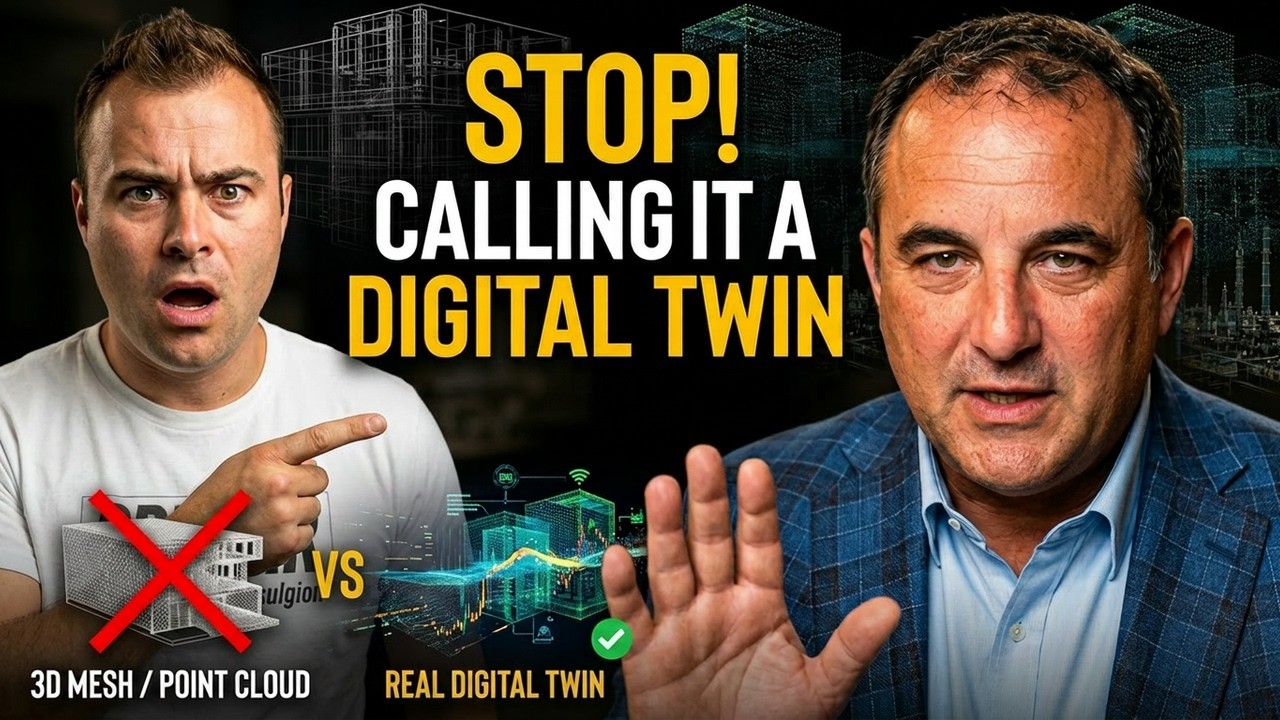
On its own, no. The two guests who spent whole episodes on the question – Barry Bassnett and Kelly Watt – both say a point cloud, mesh or Matterport tour is not a digital twin by itself: Barry Bassnett calls it a “visual twin” or a “3D postcard”, Kelly Watt calls it an ingredient. A scan becomes part of a twin when information is attached to it, it is connected to the data people work with, it is kept up to date, and it helps someone make a decision. The guests disagree on whether a twin needs 3D at all – and in practice the word is used for very different things, from unbuilt apartments to a live globe of planes.
At a glance
What it is
3D scan (point cloud, mesh, virtual tour): A record of what a place looked like when it was captured
Digital twin: A representation connected to the data and decisions that matter for the asset
Data
3D scan (point cloud, mesh, virtual tour): Geometry and images
Digital twin: Geometry or images plus tagged assets, documents, systems and sensor data
Time
3D scan (point cloud, mesh, virtual tour): A snapshot – a historic document once things change
Digital twin: Updated as the asset changes (rescans of the areas that changed, live feeds)
Questions it answers
3D scan (point cloud, mesh, virtual tour): What does it look like? Where is it?
Digital twin: What is it, when does it need service, what if we change something?
Who uses it
3D scan (point cloud, mesh, virtual tour): Project teams, designers, surveyors
Digital twin: Operations: maintenance, facility and asset managers, onboarding – and the decision makers above them
Accuracy
3D scan (point cloud, mesh, virtual tour): As high as the scanner allows
Digital twin: Only as high as the use case needs – often far below scanner accuracy
What practitioners mean by a digital twin
Barry Bassnett, a digital twin practitioner and cartographer, uses the strict definition: a twin lets you ask “what if”, it is interoperable, and information flows both ways. Kelly Watt, who led the operational digital twin programme at Dallas Fort Worth airport, follows the Digital Twin Consortium’s maturity levels: the point of a twin is a decision – predicted, simulated or automated.
Nikhil Sawlani of MultiSet AI puts the emphasis on “live”: a twin should update as reality changes and unlock more value than a 3D view. Filip Fejdi of WOOW Studio admits there are many definitions – and uses the word for something that doesn’t exist yet (see the last section).
“A digital twin is one where you have the ability to ask the what if question. What if we change the temperature? What if something happened? It has to be interoperable. It has to be a two-way flow of information.”
“A digital twin, according to me, is a live representation of any physical space, and it should unlock more value than just being a 3D representation.”
Point cloud, mesh, Matterport tour, BIM model: twin or not?
Barry Bassnett’s verdict: not a twin, but a visual twin – useful for training and familiarisation, yet still a “3D postcard” until information is attached. Kelly Watt agrees a Matterport capture is not a twin on its own, even though the DFW programme used around 1,400 Matterport projects tied to GIS as one component. In Kelly Watt’s analogy, the scan is the bag of flour, not the cookie.
A BIM model on its own isn’t a twin either, per Kelly Watt – but overlaying design and scan for clash detection, adding attributes, linking project management and costs, then machine learning and what-if scenarios gets “damn close”. Nikhil Sawlani’s version: if you stop at the static point cloud, you are one step behind.
“You've got these beautiful 3D models, point clouds, meshes, and basically they're just 3D postcards.”
“I'll agree to that. But I'll use them in my twin program. I had 1,400 Matterport files, projects that were tied to GIS and brought into the DFW project. So I think they're a component, but I don't think they're a twin on their own.”
“Do you call your bag of flour a digital twin?”
What turns a scan into a twin
The scan is the easy part, says Barry Bassnett; the work is people “harvesting” knowledge and tagging it to the model so things can be found – where an asset is, when it was captured, what it is and why it matters. Kelly Watt’s test is that combining the data must add meaning: one plus one has to be more than two.
Connection is the other half. Filip Fejdi’s twin syncs both ways with the developer’s CRM; Barry Bassnett links the model to the documents and emails about each pump. Kelly Watt warns not to assume the data exists: at DFW the team often had to install sensors first, and “real time” is itself a slippery term.
“Some people think there's some magic button, that you do a laser scan, it converts into a digital twin. Well, it doesn't. You've just gotta have a human harvesting of knowledge to attach the information to it to make it usable.”
“If it's a digital twin, one plus one can't equal two. It has to be a higher number.”
Start with the business problem, not the scan
Both main guests put the problem first. Kelly Watt’s checklist: what is the business problem, who is the stakeholder, which human workflow becomes digital, and can the ROI be quantified – some problems don’t need 3D at all. Barry Bassnett’s advice is to solve one problem, because that earns the right to solve the next.
Barry Bassnett’s paper-mill example shows how small that can start: a 360° tour made for marketing became a maintenance tool once every grease and oil point was tagged, and the company now wants it across its global network – for that one use. At DFW, Kelly Watt says, the twin targeted technicians’ wrench time and ended up used by around 350 people a day. Barry Bassnett’s sales line: you’re selling time saved, not a twin.
“If you can't make a business use case, you have no business doing it.”
“Find one problem and solve that. 'Cause when you solve that, then other people will ask you to solve their other problems in that organization.”
“We're not selling digital twins, we're selling time saving.”
How accurate does a twin need to be?
Less than surveyors expect. Barry Bassnett says facility users mostly need to know which room an item is in, that a twin can even be built from 360° imagery, and that accuracy drives cost – though a multi-storey twin must not “twist”. Kelly Watt captured DFW’s plant rooms with Matterport because dimensional accuracy wasn’t needed there, and says training needs only visual accuracy.
Accuracy still matters where it matters: Kelly Watt recalls a capture that ended up 14 feet off because survey control wasn’t used properly. Rami Tamimi makes the same distinction from the surveying side – asset inventory doesn’t need the highest accuracy, design work does.
“There's lots of applications where I need accurate geometry. Not as many as most surveyors think.”
“You just wanna know it's in room 203, and it needs fixing.”
“You don't need the highest level of accuracy. You're not trying to design anything.”
Keeping it alive
A twin that isn’t updated becomes a historic document, says Barry Bassnett – and for firefighters relying on an old layout, a potential fatality. Kelly Watt’s answer is to treat reality capture as a funded programme rather than a project, rescanning the areas that change instead of the whole plant, because project data otherwise ends up in a “data graveyard”.
Others describe where this is heading: Ben Williams of Exyn Technologies talks about continuous digitisation by autonomous systems that keep the model current, and Zlata Karpushina of FJ Dynamics says scanning’s long-term value for owners is a reliable digital record of the building.
“A digital twin is only a digital twin if it's updated. Otherwise, a historic document.”
“Data goes to the graveyard after the project.”
“All of those benefit from an updated digital model that you can run simulations on, understand current state.”
“For them, 3D scanning creates value by turning the physical building into a reliable digital record.”
When definitions collide
Does a twin need 3D? Barry Bassnett says no – it could be a piece of paper or a program, and 3D is just the most engaging interface. Kelly Watt says a twin without any visual representation is “absolutely not” a twin, but something like system monitoring.
In practice the word stretches further still. Filip Fejdi’s WOOW Studio builds twins of apartments that don’t exist yet – exact replicas synced with live sales data. Bilawal Sidhu calls a live layer of every plane on the planet a digital twin, with the 3D globe as a backdrop. Nikhil Sawlani defines a twin as live, yet uses existing scans as the twin MultiSet’s navigation runs on. Kelly Watt’s conclusion: not everyone is on the same page – which is exactly why buyers should ask what they’re getting. Arek Szadkowski adds Esri’s angle: the twin has to be “living” – updated, fed by real-time data and sensors – rather than a static model.
“A digital twin doesn't have to be a 3D model. It could be a piece of paper. It could be a program.”
“Do I think you have a digital twin without having any type of visual representation? Absolutely not.”
“As soon as something changes in the CRM, it's reflected in the front end in our digital twin and vice versa.”
“You just need tens of thousands of volunteers to build a digital twin of all the planes on the planet.”
“Esri and the ArcGIS is helping to build living digital twins. For us, this, the word living is very important.”
Questions
- Is a point cloud a digital twin?
- Not on its own, according to Barry Bassnett and Kelly Watt: it is a visual twin or an ingredient. It becomes part of a twin when information is attached, it is connected to business data and kept up to date.
- Is a Matterport tour a digital twin?
- Kelly Watt calls it a component, not a twin – yet used around 1,400 Matterport projects as part of the DFW airport twin. Barry Bassnett says it is fine for short-term jobs, but wants data ownership and an exit strategy for a long-term twin.
- What is the difference between a BIM model and a digital twin?
- Per Kelly Watt, a BIM model is an interpretation; combined with reality capture, attributes, project management, costs and what-if scenarios it gets very close to a twin. Barry Bassnett says facility managers rarely open BIM files at all.
- How accurate does a digital twin need to be?
- Only as accurate as the use case requires: Barry Bassnett and Kelly Watt both say most operational uses need far less than scanner accuracy, while survey control still matters at scale.
Every statement above comes from what guests said on 2DIAMR, attributed to them – these are their experiences and opinions, not 2DIAMR’s own measurements.