

Guest on 2D Is Against My Religion
Ben Williams
CEO, Exyn TechnologiesAt the time of the episode: COO, Exyn Technologies
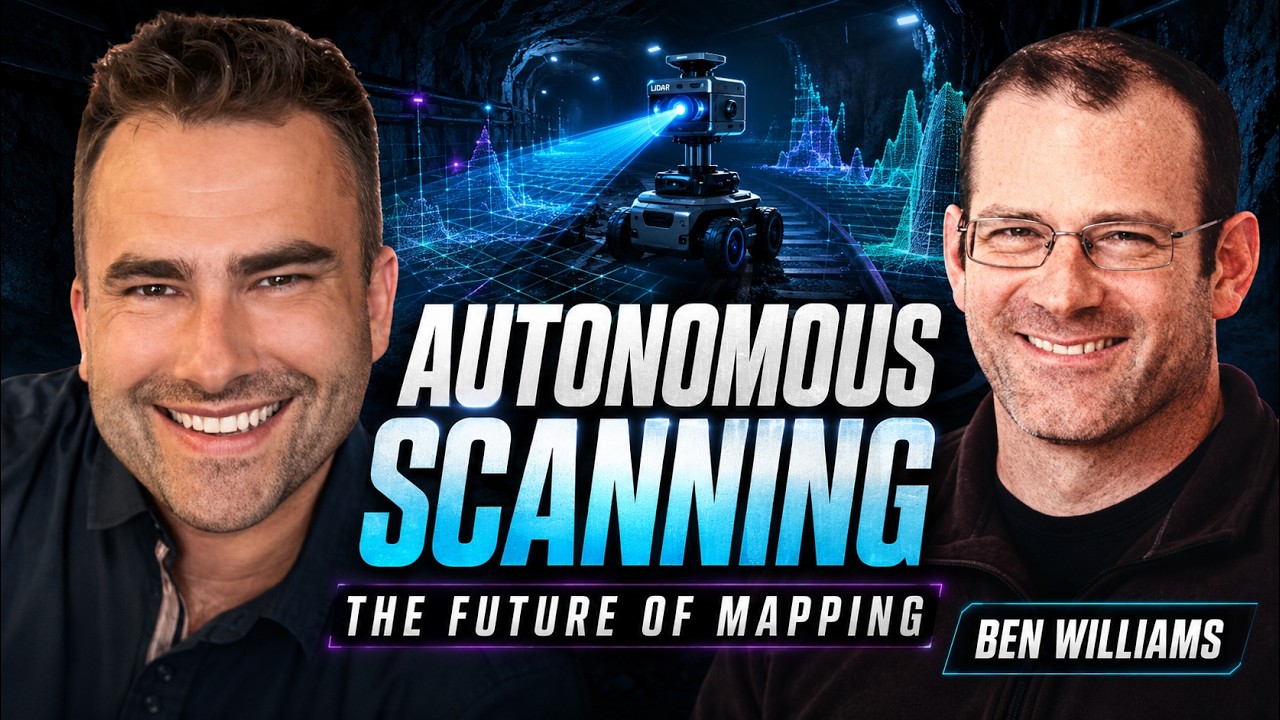
LinkedIn ↗Ben Williams leads Exyn Technologies, which builds autonomy for drones and robots that scan mines and other hard-to-reach places. On 2DIAMR, Ben Williams explained the difference between automation and autonomy and where autonomous scanning goes first.
Episode
 1 h 31 min
Podcast
The future of 3D scanning is autonomous – Ben Williams, Exyn Technologies
Ben Williams · Exyn Technologies
In Ben’s words
“A customer isn't gonna buy something just because it's autonomous, 'cause it sounds nice.”
“The specific role of someone carrying around a tripod scanner and doing a whole field survey, that specifically, I think that'll go away.”
“They just took the drone, duct taped it to the hood of their car, turned on the scanner and drove 10 kilometers down this mine approach.”
Quoted in our tech guides
Will AI and robots replace 3D scanning operators and surveyors? What 9 practitioners say →
- “Level four is where our systems operate, and that's where the operator is not flying the system at all.”▶ 13:17
- “What I'll call the low-hanging fruit here is all of the most dangerous elements of people's operations, those are the places where autonomous systems go first.”▶ 22:10
- “It removes the direct link of one operator to one system, and instead becomes a manager of systems, a manager of data collection, basically.”▶ 86:14
- “We can't find anybody, so we need this team that exists here to be able to cover what would've been three teams before.”▶ 29:33
- “A customer isn't gonna buy something just because it's autonomous, 'cause it sounds nice.”▶ 18:56
Is a 3D scan a digital twin? What 9 practitioners say →
- “All of those benefit from an updated digital model that you can run simulations on, understand current state.”▶ 85:14
Do you need a licensed surveyor for 3D scanning? What 8 practitioners say →
- “The specific role of someone carrying around a tripod scanner and doing a whole field survey, that specifically, I think that'll go away.”▶ 31:26
Questions Ben answered
- When is autonomous 3D scanning worth the cost compared with a human survey crew?
- Per Ben Williams of Exyn Technologies, it pays off fastest where highly trained surveyors spend time on routine capture, where data was too dangerous or impossible to get, and where teams simply can’t hire enough people. ▶ 25:07
- How does an autonomous drone scanner correct SLAM drift without GPS?
- Ben Williams says Exyn’s system uses its best localization source and corrects drift with any GPS fixes or surveyed control points it gets – down to a couple of centimetres over a long capture with a few GPS fixes – and backtracks when its fix degrades. ▶ 67:08
- How heavy is the Exyn Nexys payload and which drones can carry it?
- Per Ben Williams, the Nexys weighs roughly 2.5–3 kg, so it needs a standard industrial drone such as a DJI M350, a Freefly Astro Max or a CHCNAV model; Exyn keeps the list of supported drones on its website. ▶ 60:18
- Do you still need a terrestrial laser scanner if you scan with SLAM?
- Ben Williams says 80–90% of survey data doesn’t need millimetre accuracy, so customers often build the base map with a Nexys-based system and use a TLS only for the areas that need the highest precision. ▶ 71:25
- How does an autonomous robot decide where to scan next?
- Per Ben Williams, Exyn turns the live point cloud into voxels marked occupied, free or unexplored, and the drone or robot keeps pushing towards the unexplored frontier until the defined volume is mapped. ▶ 61:09
Talks about
Related guests
- Rami Tamimi – Geomatics project manager and Ph.D. candidate, WSP
- Zlata Karpushina – Go-To-Market Strategist, FJ Dynamics
- Mehdi Boroumand – SLAM scanning practitioner, Australia
- Olaf Freier – CEO, HINTE Expo & Conference (organiser of INTERGEO), INTERGEO
- Dylan Gorman – Drone mapping, PilotByte Labs
- Michael Schoelkopf – Director, Product Management Reality Capture, NavVis