
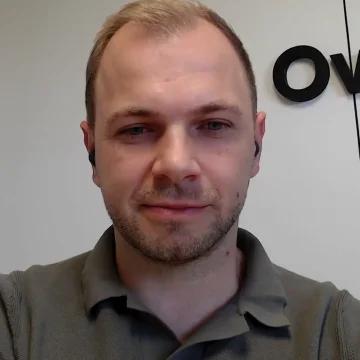
Guest on 2D Is Against My Religion
Tomáš Barnáš
Co-founder of LumiSway and Overhead4D; producer of Smithsonian Starstruck, Overhead4D
LinkedIn ↗Tomáš Barnáš co-founded the reality capture company Overhead4D and the drone show company LumiSway, produced the Smithsonian Starstruck VR experience and co-founded the 3DISE conference. On 2DIAMR, Tomáš Barnáš also co-hosts the 3DISE @ INTERGEO series.
Episodes
 19 min
 1 h 19 min
Podcast
Astronomers rejected our Milky Way: making Smithsonian Starstruck in VR
Tomáš Barnáš, Elliott Mizroch
In Tomáš’s words
“When you have 3,000 drones, it means you have 3,000 pixels. But if you have 300 drones, you have 300 pixels.”
“With these 300 drones, we can really do a cool show.”
“It's crazy that even at 10 meters per second you are able to make from 300 drones one straight line in the air and they're not moving.”
“If you want to stream full experience, the maximum headsets you can have in one room is 16.”
Quoted in our tech guides
Do you need a licensed surveyor for 3D scanning? What 8 practitioners say →
- “Licenses are European, so we actually don't have a limitation. You just need to contact the right authorities, and some of them require specific permissions or specific insurances.”▶ 8:54
Questions Tomáš answered
- How are 3D scans used to design drone light shows?
- Per Tomáš Barnáš, LumiSway’s first show, for the European Capital of Culture, was designed on top of a 3D scan of the castle it flew over, so the team could simulate the show and make sure no drone crashes into the castle. ▶ 2:04
- Can a 300-drone show look as good as a 1,000-drone show?
- Tomáš Barnáš says yes: 300 drones are only 300 “pixels” and harder to design for, but with the right designers LumiSway’s 300-drone shows can compare with 1,000-drone shows that did not look much better. ▶ 9:39
- What permits does a drone show need in Slovakia?
- Per Tomáš Barnáš, each show needs at least 30 days of paperwork with air traffic control, the airport tower and, over a river, the river authorities; setting up LumiSway’s permissions took about a year. ▶ 5:31
- Can a drone show company fly anywhere in Europe?
- Tomáš Barnáš says drone show licences are European, so LumiSway has no limitation; it only needs to contact the local authorities, and some places require specific permissions or insurance. ▶ 8:54
- Can drone show drones fly in rain and wind?
- Per Tomáš Barnáš, LumiSway’s show drones resist rain and snow; rain causes more trouble for the radio signal than for the drones, and officially they should not fly in wind above 10 meters per second. ▶ 15:29
- What is Smithsonian Starstruck VR?
- Per Tomáš Barnáš, Starstruck is a roughly 40-minute VR experience – an interactive documentary – with 12 stops, guided by a flying astronaut, built on research from Smithsonian astrophysicists about the life of stars. ▶ 1:31
- Where can you see the Smithsonian Starstruck VR experience?
- At the time of recording, Tomáš Barnáš said it ran in around 10 places, including Melbourne, Chicago, Washington DC, San Antonio and Denver, with Santiago de Chile opening next and the London Science Museum among the museum venues. ▶ 70:37
- How do free-roam VR headsets stay tracked in a large venue?
- Per Tomáš Barnáš, high-contrast patterns on the floor and walls give the standalone headsets corners and edges to track, which prevents drift; some venues also use ArUco markers, similar to AprilTags, to help the experience load faster. ▶ 60:18
- How was the black hole in Starstruck made scientifically accurate?
- Elliott Mizroch says black-hole expert Laura Brenneman allowed only the Interstellar black hole as a Hollywood reference; Tomáš Barnáš adds that the team turned its dramatic fog into a flat disc and did not let visitors step inside, since no one knows what is there. ▶ 34:50
- How much space does a museum need for a free-roam VR experience?
- Per Tomáš Barnáš, the original target was museums with over one million visitors a year and 300–500 m² of space, but after Venice ran on about 80 m² – installed in four days – smaller setups are open for discussion. ▶ 73:10
Talks about
Related guests
- Olli Huttunen – 3D Gaussian Splatting creator
- Elliott Mizroch – Director, Smithsonian Starstruck
- Dylan Gorman – Drone mapping, PilotByte Labs
- Rami Tamimi – Geomatics project manager and Ph.D. candidate, WSP
- Nikhil Sawlani – Founder, MultiSet AI
- Arash Keissami – CEO, NIRA