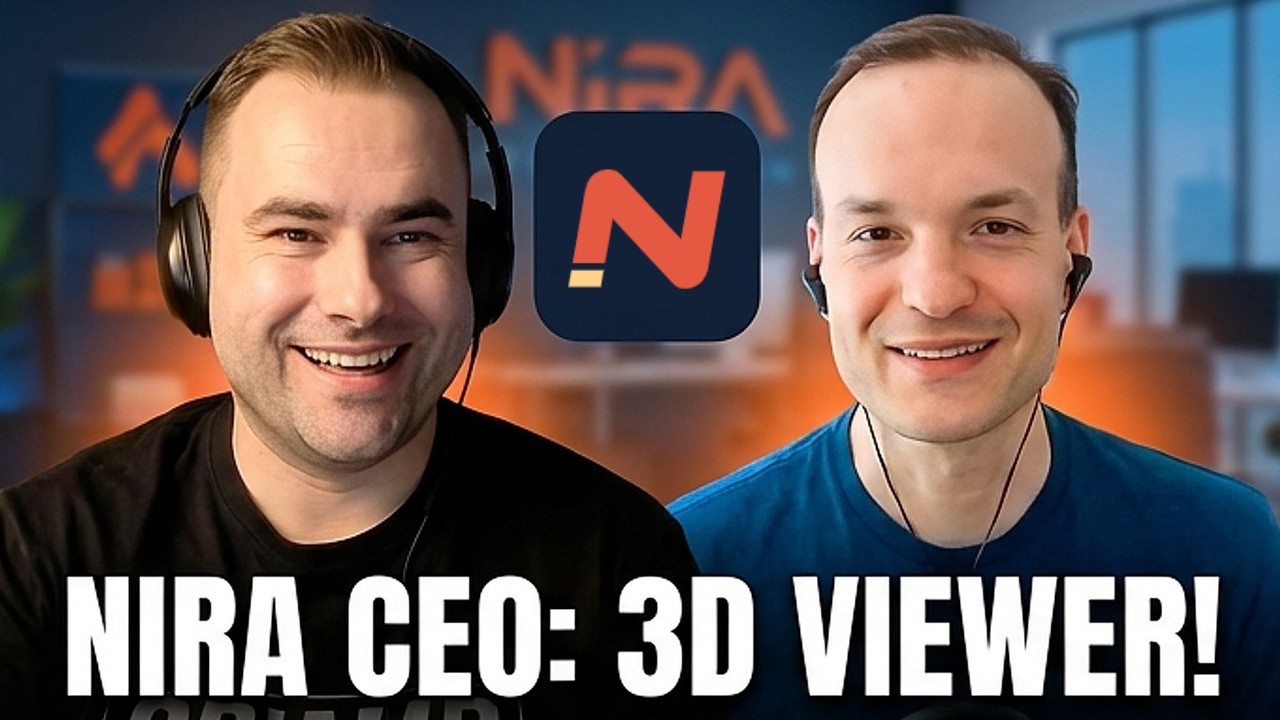
Arash Keissami is the CEO of NIRA, a platform that renders very large 3D datasets on servers and streams them to any device. On 2DIAMR, Arash Keissami compared meshes, point clouds and Gaussian splats for sharing 3D online.
Episode
 1 h 23 min
In Arash’s words
“Everything looks the same, whether you're using a super high-powered workstation or a 10-year-old mobile phone.”
“By doing server side rendering, the data always stays on the servers and the data's never transmitted to the client, so there's no way to extract the data.”
“I still feel like we're in the very, very, very early stages of Gaussian splats, and I feel like a lot can still happen.”
Quoted in our tech guides
Questions Arash answered
- Why do large point clouds and photogrammetry models crash in the web browser?
- Per Arash Keissami, there is no fixed limit, but with client-side rendering browsers start crashing at many gigabytes or even hundreds of megabytes, depending on the device and vendor limits such as Apple’s memory per browser tab. ▶ 24:04
- Can NIRA be used in VR headsets like Apple Vision Pro or Meta headsets?
- Not natively, Arash Keissami says: NIRA has no VR or AR support yet because of streaming latency; it only built an AR prototype. Opening NIRA in a headset’s browser works, but as a big flat screen rather than immersive VR. ▶ 43:31
- Do two 3D scans need to be georeferenced to compare them over time?
- Arash Keissami recommends RTK and ideally GCPs; otherwise align once, take coordinates of unchanged points from NIRA and use them as “fake GCPs” in the next reconstruction. NIRA plans to let users set coordinates inside the app. ▶ 47:07
- Can you add more point clouds to an existing NIRA dataset?
- Not yet, per Arash Keissami: NIRA builds an acceleration structure (an octree) from all point clouds together, so they must be uploaded at once; appending point clouds later is planned. ▶ 71:19
- Should you keep normals and PBR data when uploading a photogrammetry model to NIRA?
- Arash Keissami says no: photogrammetry has its lighting baked in, so stripping that data makes it load and render faster. Full PBR data is worth keeping for models made in design or CAD tools that use virtual lighting. ▶ 72:15
Talks about
Related guests
- Olli Huttunen – 3D Gaussian Splatting creator
- Michael Schoelkopf – Director, Product Management Reality Capture, NavVis
- Barry Bassnett – Digital twin practitioner, author of Tower of Twins
- Zlata Karpushina – Go-To-Market Strategist, FJ Dynamics
- Mehdi Boroumand – SLAM scanning practitioner, Australia
- Tomáš Barnáš – Co-founder of LumiSway and Overhead4D; producer of Smithsonian Starstruck, Overhead4D