
Expo & conference podcast· 26 min
NavVis VLX 4 and CLX: what the new Hesai LiDAR changes – Michael Schoelkopf
Watching here? Subscribe on YouTube.Get the next 2D Is Against My Religion episode in your YouTube feed.
SubscribeListen to the audio
Summary
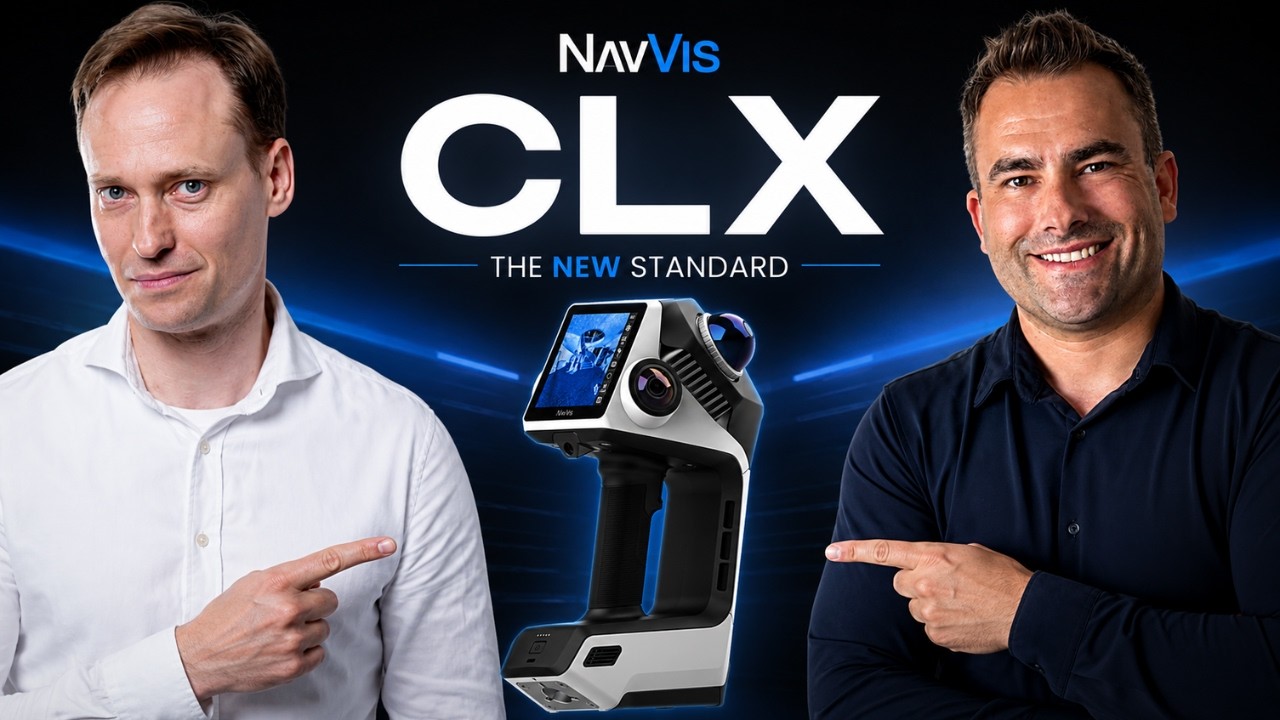
Recorded live at INTERGEO 2026, Michael Schoelkopf, Director of Product Management Reality Capture at NavVis, tells Michal Gula and Tomáš Barnáš how the CLX launch was planned for over two years while the VLX 4 was a five-month secret decided days before the show, what its new Hesai LiDAR changes, where the VLX 3 still wins, why NavVis takes orders without a delivery date, and why any brand could scan in the Experience Park.
Key ideas
- 1Per Michael, the CLX was about 26 months in development, while the VLX 4 started in February as a project few people at NavVis knew about, and the official go was given the Thursday before INTERGEO 2026.
- 2The new Hesai sensor was developed with dynamic reality capture in mind, per Michael: a beam spot about 90% smaller, range precision improved from 5 to 3.5 mm, true resolution down from 5 to 3 mm and 1.7 million points per second, with an estimated 4 mm accuracy in the preliminary spec (as of October 2026).
- 3Two LiDARs on the bottom of the VLX 4 cover the new sensor’s 40-degree blind spot and deliver the extra points the higher resolution needs; the cameras stay the same, and some algorithm improvements carry over to the VLX 3 and CLX.
- 4Michael still recommends the VLX 3 for long-range outdoor work, because the new sensor has about half the range; the VLX 4 targets fine detail such as MEP and industrial sites, where VLX 3 data used to be complemented with a terrestrial scanner.
- 5NavVis takes VLX 4 orders without committing to a delivery date until Hesai starts series production – per Michael the only responsible option – and does not share VLX 4 benchmark data yet, while data from existing devices is not a problem.
Quotes
“If you today think about buying a TLS, you should look at the VLX 4.”
“You can order it today. We don't commit to a delivery date.”
“I don't think a dynamic laser scan will ever catch up on that.”
Quoted in tech guides
Questions answered
- What is new in the NavVis VLX 4?
- Per Michael Schoelkopf, a new Hesai LiDAR built for dynamic reality capture: a beam spot about 90% smaller, true resolution of 3 mm instead of 5 mm, 1.7 million points per second and an estimated 4 mm accuracy in the preliminary spec (as of October 2026).
- When will the NavVis VLX 4 ship?
- NavVis takes orders but does not commit to a delivery date until Hesai starts series production, Michael Schoelkopf said at INTERGEO 2026; some units may ship that year, with no promise.
- NavVis VLX 3 or VLX 4 – which one for outdoor scanning?
- Michael Schoelkopf still advises the VLX 3 for long-range outdoor work, because the new sensor in the VLX 4 has about half the range; the VLX 4 is for capturing the finest detail, such as MEP.
- Will dynamic laser scanners replace terrestrial scanners?
- Not on range, per Michael Schoelkopf: the VLX 4 will capture more of the detail that used to need a TLS, but Michael doesn’t think a dynamic scanner will ever catch up with TLS range.
- Why does the NavVis VLX 4 have two LiDARs at the bottom?
- Per Michael Schoelkopf, to get the extra points per second that higher resolution needs and to cover the new sensor’s 40-degree blind spot.
Chapters
Transcript
Full transcriptabout 20 min readShowHide
Transcribed automatically (ElevenLabs Scribe) and lightly edited. It may contain small errors in words or speaker names. Click a time to play the audio from there.
Michal Gula: so I, I just came back from the interview in, in your booth, and, I was honestly expecting like do the five to 10 minutes, like a quick walkthrough and, and some questions and everything else because, like, we wanted to do some, some short video and then something on YouTube. I spent there 35 minutes. You said that I'm asking too many questions, but like I was really interested. Like, we were, we were... I was trying the, the CLX, the new CLX from, from the NavVis, which is quite a big deal. You released it, on the 1st of September. I'm wondering, how did you feel about the new device internally? Like, like before, like did you have some hesitations? Did you... Were you nervous? Like, like what was the atmosphere in, in the company? By the way, sorry, Michael Schoelkopf from, from NavVis is here.
Michael Schoelkopf: So, we know each other already from last year, so... And we had a talk also on 3rd of September or something like that-
Michal Gula: Yeah
Michael Schoelkopf: so just quickly be- after the launch. So how did you feel internally about the launch of, of CLX? so the NavVis CLX launch was planned for quite some time. in total, we had approximately like 26 months that we had, where in develo- development. So first engineering teams and product coming in, and then later also marketing, et cetera. So it was like a build up if you want. So right, every- by knew it's coming, we had everything prepared, et- et cetera. So it was really nice. We had then the launch and the quick launch party in the beginning, right? When the website went live and LinkedIn went live, et cetera. so I think that was a very good feeling of the company like achieving this after quite some work. It was a bit more difficult with the VLX 4, where we probably come to in a second.
Michal Gula: that would be the, the, the next question because this was a really big surprise. during the summer, I think I, I found out about the preparing of, of the CLX. of course, everything was, kept very like under the cover and then, like now I can be honest, I was really trying to find some information about it on the internet. there was none. And, even I think ChatGPT were... No, ChatGPT was expecting something because it found, you were claiming for trademark, like maybe two years ago or, or, or so, right?
Michael Schoelkopf: What a deep research.
Michal Gula: No, he-- Michael asked, just asked me whether I work for FBI because I, I'm asking so many questions, so... No, I, I really did the research. And, and so, what you did with the VLX was maybe even more of a surprise.
Michael Schoelkopf: Yeah. So that is what I meant, like with, with NavVis CLX, it was clear for everybody in the company, we launch this product, this will be before INTERGEO, right? Because INTERGEO is one of the most important events of our industry. So that was pretty clear. Timeline was clear. For VLX 4, that's a completely different thing. For VLX 4, we took decision in February that we will try to build a VLX 4 with a new LiDAR. There was work of five months without knowing many people in NavVis. So because it was unclear, like if you can achieve, I mean, this is a s- new sensor, and normally you would say, well, if a sensor is coming out, then if it's really in production, you then really can build up a device on it. And the sensor is the most important component of any laser scan. But in this case, we saw such a big opportunity that we said, "Okay, we want to get the samples as quickly as possible and to see what we can get out of them." And when we looked at first data of that, we thought, "Okay, that really can be a step change in this industry." And we got more sample of Hesai, so it felt like Hesai is producing one more sample. We get it the next day, so it was crazy. Every sample was a bit different. But we said, "Okay, do we really want to launch this device? We have some reputation, so it has to really have this quality standard of NavVis." It was unclear if we can achieve this in this very tight timeline. So the official decision was taken last Thursday.
Michal Gula: Really? Nice.
Michael Schoelkopf: So obviously, we already have planned with this launch. So in term... I mean, you have planned, like r- marketing, sales, operations, et cetera, has to plan that. But the official decision was taken on Thursday, and then we informed very, very few people outside of NavVis before the launch on Monday. Then Monday, 4:00 PM, just 12 hours or so, well, 16 hours before INTERGEO-... we launched the NavVis VLX 4 on the website. And it was meant as an launch light. So we said, "Okay, we are now on the website. We have a LinkedIn post, et cetera." But then we said, "Okay, well, nobody trusts what you say," and rightfully tho- so, we should always back it up with data. So we looked at the best data that we got and provided the sample data. So people could download, I think maybe it was not Monday, maybe it was Tuesday, I'm not entirely sure, could download sample data of the VLX 4 because that's a super strong argument, right? I mean, everybody can claim anything about any data that they produce, and I know you like our design, industrial design of our devices. They are beautiful, but nobody cares. In the end, it's what kind of data do you have, what kind of reliability they have. So yes, it was a big surprise. I think I googled it, like, an hour or two hours before, looked at ChatGPT, Claude, if there are any leaks. Nothing. So it was li- li- literally like nobody knew. At 4:00 PM, we told everybody of our distributors in all the indirect regions, and yeah, so that was-
Tomáš Barnáš: So what, what-
Michael Schoelkopf: It's a pretty cool story though
Tomáš Barnáš: what, what's-
Michael Schoelkopf: It, it was insane
Tomáš Barnáš: what-
Michael Schoelkopf: It drove me insane, honestly. I mean
Tomáš Barnáš: What's that thing, about this LiDAR that made you go through this, we can say a risk, because i- if you are doing in a such a big corporation something that very fast with few people knowing, it's a, it's a risk, right? It is a risk.
Michael Schoelkopf: Well, what-- I mean, the worst thing that could have happened was until last Thursday that we say, "No, we don't think we are ready."
Tomáš Barnáš: Mm.
Michael Schoelkopf: We postpone to whatever time, and we have done, done some work in vain. Most of it probably can be shifted. I mean, if you prepare a marketing campaign, let's say, that can be shifted to a couple of months later. Anyway, it's always good if you iterate, right? I mean, if you look at how many iterations we did with different samples of the sensor, but also then different processing settings, et cetera, improving the filtering, et cetera, and this is the short timeframe, iteration are always good. So I think it's sometimes good that you have a very tough timeline-
Tomáš Barnáš: Oh, we know that
Michael Schoelkopf: because you're forced-
Tomáš Barnáš: Yes, yes, we know that, but, but it's not something the corporate is used to.
Michael Schoelkopf: So now what, what is the big difference? Um-
Tomáš Barnáš: This is what I'm asking, like, what's so special-
Michael Schoelkopf: Yeah
Tomáš Barnáš: about this LiDAR?
Michael Schoelkopf: And I think it's a very special LiDAR. The Hesai XDM that is used by everybody in the industry who wants to have best data quality, and until Monday was the best sensor on the market, it was not designed for dynamic reality capture. It was designed for automotive and robotics. What does it mean? You have a pretty large range of raw range of three hundred meters. We cut off the data at fifty meters because half of the data-
Tomáš Barnáš: Of course, yeah
Michael Schoelkopf: is just, like, not valuable anymore. But the MT sensor was developed having dynamic reality capture in mind. In fact, the last two years, our electrical engineering department gave a lot of feedback to Hesai what is needed to have really the best sensor for such, such a device. And one of the most important of the specs is the beam diversions, so how big is your spot size in a, in a certain range? And this is shrunk by ninety percent. This is a lot. If you want to show-
Tomáš Barnáš: Ten times smaller
Michael Schoelkopf: ten times, twelve times smaller. So if you, if you want to capture the smallest detail, obviously it helps if you have a smaller beam because otherwise you just smoothen it out.
Tomáš Barnáš: Yeah.
Michael Schoelkopf: And seeing this level of detail convinced us that we will have a product with this, and it will be the best dynamic laser scanner on the market. There was just also like, okay, what are the downsides of the sensor? And we saw some noise issues, et cetera, where we could work also with Hesai to improve that. So that's again, like, this feedback loop, right? Hesai producing something, we giving some feedback on that when we tested it. It's amazing, the collaboration with Hesai. I think they're super responsive. It was super quick, amazing. however, we are only at the start. So production of Hesai didn't start yet. That means we expect that when we have the production samples, we have it more stable, et cetera, every sample will be the same, and we will get even better data quality. And then over time, we also will improve our algorithms, et cetera, to get even better data out of it. I mean, it-
Tomáš Barnáš: So you're still not selling the device with this?
Michael Schoelkopf: You can order it today. We don't commit to a delivery date.
Tomáš Barnáš: Okay.
Michael Schoelkopf: I think it's just, like, the only thing that you can do responsibly because if you have a project in four, four weeks, let's say, I could promise you that you get this device before. But we can't because the series production haven't started at Hesai.
Tomáš Barnáš: Okay, but generally speaking, like, if I pre-order it today or order it today, like, is there a chance I will get it by under the Christmas tree? Like-
Michael Schoelkopf: There's a chance, but there's no promise.
Tomáš Barnáš: Okay.
Michael Schoelkopf: So, we do plan to sell some of these units this year still, but that depends totally on Hesai, and again, Hesai on their supplier. So it's just in my opinion, the only responsible thing you can do is to say, "Well, look at the data right now that we have. If you want, we are very happy if you, order it, of course."
Tomáš Barnáš: Yeah.
Michael Schoelkopf: That is what we want to do, that, our customers order these devices. We can't commit to a shipping date. Over time, when Hesai start the series production, we get the devices, then we can say, "Okay, now you get it in, whatever, two weeks, four weeks, six weeks," whatever it might be. Right now, we can't promise this.
Tomáš Barnáš: Okay. So, I, I just wanna confirm that I understand it right. Like, the, the main difference is that the, the laser beam that is shooting, that is being shot, it has, like, ninety percent smaller diameter At some distance, right? Compared to the previous one. Okay, so this gives us better detail. it doesn't have anything with the accuracy, right? Of-
Michael Schoelkopf: So the other spec, they also improved, precision, range precision from five to 3.5 millimeters. That helps. what we currently have in our preliminary spec sheet is, that we es- estimate a four millimeter accuracy, so that's an improvement of 20%, before we had five millimeters accuracy. It's a bit unclear because, again, it depends on serious production how good that really will be, but that is what we currently see with our samples. so that is one thing. accuracy from five millimeters to four millimeters. Then point cloud density, and when I say density or resolution, I mean true resolution in the sense of these were measured points and not interpolated. So here we go down from five millimeters to three millimeters because you have the opportunity to do that with, like, the small beam size. More points per seconds, which you need if you have higher density. If you double the density, you need to quadruple the points, so we have 1.7 million points per second. and then again, as you said, like, a level of detail is also greatly improved. I don't know of any KPI of that, but, or spec- but if you look just at sections, for example, you would definitely see that there's a, much more-
Tomáš Barnáš: Ca- camera sensors will stay the same-
Michael Schoelkopf: Yes
Tomáš Barnáš: or are you still thinking about-
Michael Schoelkopf: They're same.
Tomáš Barnáš: Okay. And software wise, any updates driven by that or not really required?
Michael Schoelkopf: So, so indeed, when we try to get the best out of a sensor, we adapt our existing algorithms, and some of this will also carry over to the VLX 3. So some of this will also improve the quality of this VLX 3, and also has improved quality of the CLX. but the step change that you have is based on the sensor. so yes.
Tomáš Barnáš: the overall design staying the same, so you only had to change the part where the lidars are or?
Michael Schoelkopf: Yeah, indeed. So on the top we have one LiDAR, same as before. On the bottom we have two lidars.
Tomáš Barnáš: May- maybe you can, you can pick it up and, and show it to the camera.
Michael Schoelkopf: Yeah, just have a f-
Tomáš Barnáš: You can move the mic. Feel free. this camera is yours.
Michael Schoelkopf: Yeah. Okay. So I have the dope.
Tomáš Barnáš: But now we have to take the mic back.
Michael Schoelkopf: I-
Tomáš Barnáš: We didn't say it will be easy podcast. Ah.
Michael Schoelkopf: So I don't... I have no clue if I'm completely in the picture with this. So LiDAR on top, two lidars on the bottom. So why two lidars? There are two reasons for this. The first is, as I just said, like if you have higher resolution, you need more points per seconds. the second is this LiDAR has a blind spot, so because of the mechanical construction it has, like, a 40-degree blind spot. These blind spots are basically-
Tomáš Barnáš: upwards, yeah? Like-
Michael Schoelkopf: So, no, in, this direction. So-
Tomáš Barnáš: Okay
Michael Schoelkopf: those two amazing the blind spot So that means that we capture like with this, basically this area, and with this, this area. But that means double the points in every, in the Y-axis, so to say.
Michal Gula: Okay.
Michael Schoelkopf: so this is like solve- it's solved by these two lidars. They are a little bit inclined to increase the, like the angle that you capture. The VLX 3, you have 40 de- degrees. Those have 60 degrees each, and then they are tilted towards maybe 20 degrees or so, so 80 degrees is a, like a stripe that you, it capture on the side. otherwise, it's exam- exactly the same device as the VLX 3. He has one advantage where I still see the VLX... Does it work with the mic, by the way? which was further away. there's one advantage still with the VLX 3, and that is if you really have range. I said before, the XUM sensor has a raw range of 300 meters, and, at 10% reflectivity, I think it has 280. This has 40 meters as 10% reflectivity, and so that's half. so that means if you really do outdoor applications, I would still advise for a VLX 3. But if you do want to capture finest detail, I mean, look at this beam, for example, just an example, MEP, industrial engineering sites, et cetera. That is where really this level of detail is sometimes necessary and can be provided now by a VLX 4. Where before you need to complement some VLX 3 data potentially with some terrestrial laser scanner. I don't say the TLS won't have a place, but we will just be able to capture more of what at the moment the TLS was needed for. We don't touch range. I mean, there are amazing devices out there that have hundreds of meters of range. I don't think a dynamic laser scan will ever catch up on that. but for this level of detail, I think it's getting interesting. That's why I say it's a step change.
Michal Gula: maybe I'm wrong, but l- like the most of the dynamic, use cases is probably the mapping with the, l- like, train rails, right? Where you need to go quite fast capturing-
Michael Schoelkopf: Yeah
Michal Gula: a big distance-
Michael Schoelkopf: Yeah
Michal Gula: alongside. But it's still like within maybe 50 meters.
Michael Schoelkopf: Mm.
Michal Gula: Right? So, so you really don't care about the data, like above 100 meters and so, so.
Michael Schoelkopf: I, I mean, so those devices are not meant to be, for train-
Michal Gula: Yeah
Michael Schoelkopf: rails, right.
Michal Gula: No, I, I was just, just trying to, to pick up like a extreme-
Michael Schoelkopf: Yeah
Michal Gula: use case.
Michael Schoelkopf: Yeah, yeah. okay, yeah.
Michal Gula: Potential use case.
Michael Schoelkopf: Sure, sure. Yeah. So they still have their place.
Tomáš Barnáš: But that's also a good question because you also were asking it multiple times there, like, what is the optimal pace? Like, is it like the same for both or like, do you, do you require to go very slow? Because Michal tried to just break it, you know, so he was running up and down.
Michael Schoelkopf: Really? Did you break it?
Michal Gula: No. not the device. I was trying to break the data.
Michael Schoelkopf: Yeah, yeah. The same.
Michal Gula: The, the SLAM algorithm.
Michael Schoelkopf: so basically, so the VLX 4, you use exactly like the VLX 3. If you want to have high density and resolution, it does make sense a bit, be a bit s- slower because w- it's 30% more points. If you really need the quadruple points, you need to be a bit slower. and I mean, we haven't talked now of the CLX, but, yeah. So, so generally, if you map this hall, for example, you would take the same pace. If you then say, "Okay, I want to," let's say exact- like these rigs here, I want to capture them, I would take more time here to, to capture them. yeah.
Michal Gula: Yeah. it's like, okay, you have seen the data, you have seen the raw files. You can claim that this LiDAR is much better than the, than the VLX 3 is using. Do you actually have a side-by-side comparison of, of the very same data set of, of like from the same space where you can show VLX 3, VLX 4?
Michael Schoelkopf: So right now at the INTERGEO we scanned like the experience park, which is somewhere behind me-
Michal Gula: Yeah
Michael Schoelkopf: with all devices. you can look at this data in IVION. so there you can compare side by side indeed. we do have data that we have captured in our headquarter or around. We also have like side-by-side commerce, comparison. We also use it like for our development. So we have very close looks at which device is how good in which kind of environments, facades, MEP, double, sorry, H-beams, just et cetera. so yes, that makes a lot of sense for engineering and then also like, to, to able to, to, to show the customers, right? Because they also want to see that. Probably everybody, in our booth is n- now talking about, okay, what is the difference, and here you can see it.
Michal Gula: You also-
Michael Schoelkopf: I think-
Michal Gula: Yeah.
Michael Schoelkopf: Just go.
Michal Gula: You, you also mentioned the experience park. Like I would like to give you a credit for, for like putting it together with INTERGEO because, we had like multiple discussions here, and this is like amazing setup-
Michael Schoelkopf: Yeah
Michal Gula: for, for people really trying it because one thing is to get a device and try to run around the booth-
Michael Schoelkopf: Yeah
Michal Gula: where you don't have like any real-
Michael Schoelkopf: Yeah
Michal Gula: conditions and having an experience park-
Michael Schoelkopf: Yeah
Michal Gula: like this. So, did you already get like feedback from people or do, do-
Michael Schoelkopf: So, so the best feedback is it's like super busy.
Michal Gula: Mm.
Michael Schoelkopf: So we have eight CLX with us here and six, VLX 4, and it's hard to get a hold on.
Michal Gula: I asked you about that. We had a podcast, and I as- asked you exactly this question. Will you have enough devices there for all the people?
Michael Schoelkopf: Of course we will have. Yeah. So I re- I mean, it, it's in- insane. It's also like because they are in the booth, they are in the lounge, and they're in-
Michal Gula: Yeah
Michael Schoelkopf: experience park. yeah, but for CLX, you really have to wait kind of.
Michal Gula: Yeah.
Michael Schoelkopf: Like I had multiple groups where I took like three or four prospects or customers with me at the same time, because there's just too many people interested it. I mean, that's good, right?
Michal Gula: Of course. Of course. Yeah.
Michael Schoelkopf: It's good. Next time we will bring more devices. but also the VLX 4. I mean, many people scan it also with the V- with the VLX 4. And I agree, something like the Experience Park, in my opinion, is super valuable. You have to imagine, like in our industry, it's amazing because you can go on a trade show and can try out the product. I mean, if you do cars, you probably can't drive the car around, et cetera. So I think it's a huge advantage. so I would love to extend this, honestly. So I would love to extend this, also in the coming years. Um-
Michal Gula: do you think if this edition of the INTERGEO was not at your home, basically, because you are based in, in, in Munich, would you do the same size and scale of the participation if it was in Berlin or Frankfurt?
Michael Schoelkopf: I think next year is in Frankfurt, I think.
Michal Gula: Yeah.
Michael Schoelkopf: Let's see.
Michal Gula: No, but you know that it's success already, so you will do it. But, but if it was the f- for the first time.
Michael Schoelkopf: so if it was for the first time, hard to say. Um-
Michal Gula: But now it's als- yeah.
Michael Schoelkopf: Yeah. I, I mean, it, it's a huge endeavor, right? I mean, if I look at how many people are involved, like just setting this up, et cetera, and there was back and forth with the, with the, builder, et cetera. so that's... And again, we have like not only two new products, but we have also somehow unfortunately Autodesk University and INTERGEO-
Michal Gula: Yeah, we discussed
Michael Schoelkopf: are at the same time. so that makes it even a bit more challenging. And then we have like now three, sites on, on INTERGEO. Yeah, so it was a stretch. we are very happy. So we had a lot of very good conversations at the INTERGEO. I mean, basically every existing customer comes by, obviously, look at the two devices. I ask a couple of our, booth staff like, "Okay, what is more asked for?" And they, they always want to see both. So I think they are like-
Michal Gula: Now we have data
Michael Schoelkopf: everybody who uses TLS will look at the VLX 4. It just makes a ton of sense. If you today think about buying a TLS, you should look at the VLX 4. I mean, if you then decide it's not your application, no problem, but you should look at it. And if you ever tried or bought a more affordable, I still try to figure out like how I say this respectfully, a more affordable competitive device which is meant for lower quality data, you probably are intrigued to test the CLX and see what is the difference, um- for 15K. Yeah.
Michal Gula: Would it make sense-
Tomáš Barnáš: Thank you very much
Michal Gula: I have just like last-
Michael Schoelkopf: Oh, okay
Michal Gula: the last thing, like about the Experience Park, because I'm really like impressed by that, and, we were just like thinking, that people might be interested in comparing the devices. Do you think it would be interested also for company like yours, to let this Experience Park be, equipped by like 10 different, products from other brands and com-
Michael Schoelkopf: They are.
Michal Gula: They are already?
Michael Schoelkopf: Yeah. So, so, so they are like, all kind of, device are, used in the Experience Park. It's not like-
Michal Gula: Ah, okay. I thought you said-
Michael Schoelkopf: It's not, it's not only for, for-
Michal Gula: Okay.
Michael Schoelkopf: So it was sponsored by NavVis, but, everybody can take their device and, and scan it.
Michal Gula: To- Toma- Tomáš is not following my LinkedIn because I did the video about it this morning.
Michael Schoelkopf: Nah.
Michal Gula: No, but I meant more like whether you see there's a benefit for you that people can compare it. I like didn't notice how many others are there, but you know, like if you're prom- promoting just your thing, it's one. But whether you can also benefit from-
Michael Schoelkopf: Yeah
Michal Gula: like having others there.
Michael Schoelkopf: I mean, if you really want to have the comparison, then you would have to look at the data. So I mean, you test usability.
Michal Gula: Let's, let's say I would come there with this, very famous scanner. It's, it's called Michal's Super LiDAR, let's say. I will scan the site, and ask you for the benchmark data, like, like ideal data from you-
Michael Schoelkopf: Mm
Michal Gula: like with the targets and, and, with the control and everything else. Like, would you send it to me?
Michael Schoelkopf: So VLX 4 data we currently don't send out for the obvious reason that it is not as good as it will be when we ship it out to customers.
Michal Gula: That's understandably, yeah.
Michael Schoelkopf: So for our existing devices, I don't see any problem.
Michal Gula: Okay. Michael, pleasure as always.
Tomáš Barnáš: Thank you very much for coming.
Michael Schoelkopf: Yeah, you were also... Like come on. What is... These questions-
Michal Gula: Which part?
Michael Schoelkopf: are too, too, too, too tame. Too tame. Come on.
Michal Gula: I, I just did-
Michael Schoelkopf: Ask difficult
Michal Gula: I just did 35 minutes of roasting of your colleague in, -
Michael Schoelkopf: You roast my colleague Andrew Parker.
Tomáš Barnáš: You know, I, I, I-
Michael Schoelkopf: He told me you were tame. I didn't know that you were tame.
Tomáš Barnáš: I, I, I was, I, I was just like last year-
Michael Schoelkopf: No
Tomáš Barnáš: telling to him after that, like, "Man, he will never talk to you anymore." And he said like, "No, no, we are really good." And now you're asking for it.
Michael Schoelkopf: He, he, he still thinks, we hate each other. No, no, no. I will... So I take this as a compliment. If you go hard on me, I assume, that we get more interesting in, insights also for your, for your, for your viewers, and I mean, I hope I can take it.
Michal Gula: Yeah. Thank you very much.
Michael Schoelkopf: Okay. Next time I go hard on you.
Full show notes
Michael Schölkopf is Director of Product Management, Reality Capture at NavVis. NavVis came to INTERGEO with two new devices: the CLX, launched on 1 September after about 26 months of development, and the VLX 4, which got its official go the Thursday before the show and went live on the website about 16 hours before INTERGEO opened.
We get into how a five-month project stayed secret, what the new Hesai LiDAR changes (a beam spot about 90% smaller, true resolution down from 5 to 3 mm, 1.7 million points per second, an estimated 4 mm accuracy per the preliminary spec), why the VLX 3 is still his recommendation for long-range outdoor work, and why NavVis takes orders for the VLX 4 without committing to a delivery date. Plus the Experience Park, where any brand could scan, and the question Michal asked him to answer honestly: would NavVis hand over benchmark data to a competitor?
Recorded live at INTERGEO 2026 in the 3DISE podcast studio.
Hosts: Michal Gula and Tomáš Barnáš. Guest: Michael Schölkopf, NavVis.
Chapters:
0:00 35 minutes with the new NavVis CLX
0:56 26 months of CLX development
1:57 No leaks, not even for ChatGPT
2:52 VLX 4, a five-month secret
4:44 Decided Thursday, launched Monday
6:35 Why take the risk?
7:48 A LiDAR built for reality capture
10:23 Order today, no delivery date
11:32 Accuracy, density and points per second
13:10 Same cameras, better algorithms
13:43 Why two LiDARs on the bottom
15:13 Where the VLX 3 still wins
17:20 Walking pace and point density
18:18 VLX 3 vs VLX 4 side by side
19:39 The Experience Park
21:27 Would NavVis go this big in Frankfurt?
22:49 Who should test VLX 4 and CLX
23:29 Other brands in the Experience Park
24:27 Would NavVis share benchmark data?
25:02 Wrap-up
Related
 19 min
Expo & conference podcast
SLAM scanner range: 70 m on paper, 50 m of good data – Eduard Chiru, FJD
Eduard Chiru · FJ Dynamics
 30 min
Expo & conference podcast
Scanner users want answers, not point clouds – Manifold Tech & FARO INSIGHT
John Chwalibog, Fan Yang, Tobias Böhret · Manifold Tech
 55 min