

Guest on 2D Is Against My Religion
Łukasz Mirocha
Opus Lab; university lecturer in Hong Kong, Opus Lab
LinkedIn ↗Dr. Łukasz Mirocha lives in Hong Kong, where he came for a PhD in 2016; he teaches creative-industries students and runs Opus Lab, which does training for VFX studios and game developers. Łukasz Mirocha has worked with game engines for about ten years and builds Threads of Color, a playable Hong Kong made of scanned streets and AI-generated worlds.
Episodes
 1 h 24 min
Podcast
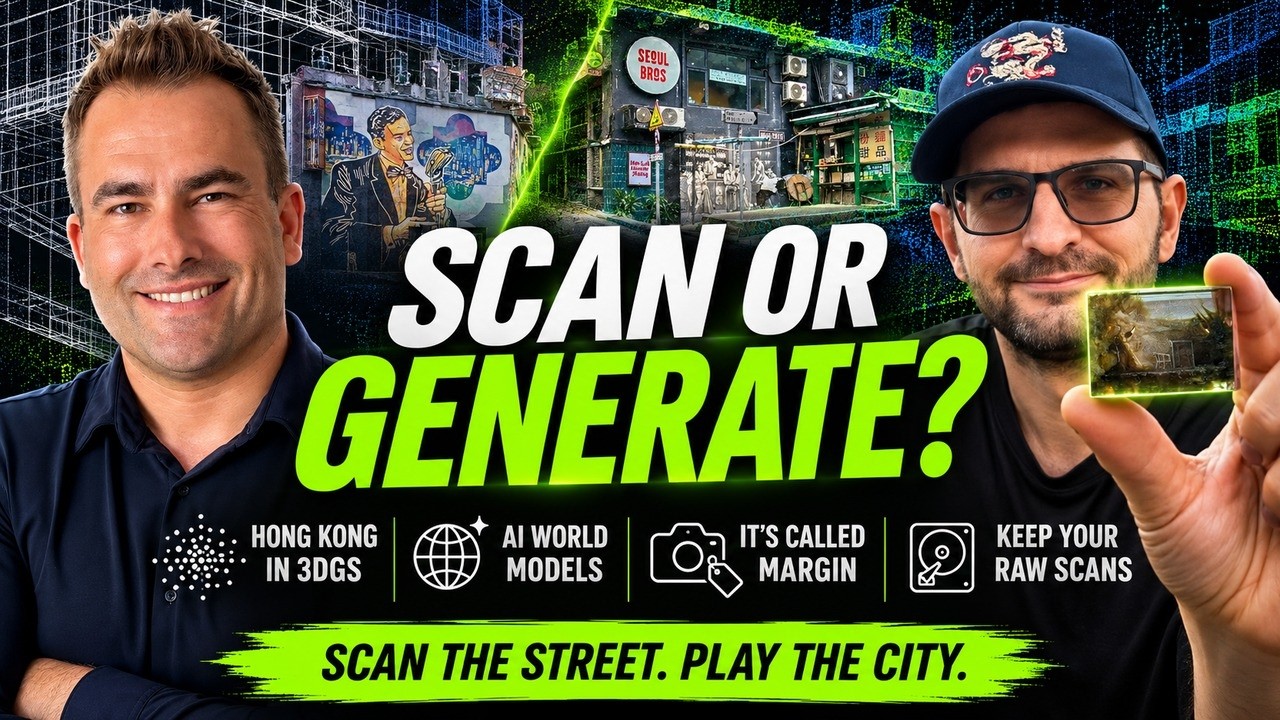
Scan or generate? 3D Gaussian splatting vs AI world models – Łukasz Mirocha, Opus Lab
Łukasz Mirocha · Opus Lab
 57 min
Podcast
3DISE 2026 warm-up: why reality capture people fly to Prague
Tomáš Barnáš, Juraj Holub, Olaf Freier, Bert Azizoglu, Rami Tamimi, Matthew Byrd, Alex Harvey, Łukasz Mirocha, Michal Ukropec · 3DISE Conference
In Łukasz’s words
“It's called margin.”
“It's already production-ready.”
“Keep your data raw, and then keep, if you can, at least one version of this data maxed out processed.”
“It's not enough guys with scanners running around the world and like scanning it.”
“This is part of the game, and you cannot really prompt it.”
“Then you're gonna realize there's no fence. You're all in the same field, basically.”
Quoted in our tech guides
Gaussian splatting vs photogrammetry: what 24 practitioners say →
- “There was no way you could actually use it in, like, any kind of real project.”▶ 43:54
Questions Łukasz answered
- When should you scan a place and when can you generate it with AI?
- According to Łukasz Mirocha, it depends on the use case: scans are the necessary foundation, but physical AI needs so much 3D data that most of it will be generated. ▶ 29:34
- Is 3D Gaussian splatting production ready?
- According to Łukasz Mirocha, yes: Threads of Color was built to show that 3DGS pipelines work in real projects, not only in demos or marketing material. ▶ 22:46
- Why don't 3D scanners have the best cameras?
- Łukasz Mirocha's answer: it's called margin. At some point makers have to cut development, release the product and hope the next model convinces you to buy again. ▶ 28:05
- Should you keep raw scan data?
- According to Łukasz Mirocha, yes: keep raw data plus one version processed at maximum settings, because new reconstruction software and optimisations keep coming; Łukasz Mirocha reprocessed January 2026 captures months later. ▶ 25:46
- How do you stream Gaussian splats on the web?
- For Threads of Color, according to Łukasz Mirocha, the team uses SOG LOD chunks by PlayCanvas and a fast storage provider (pipeline locked in mid 2026). ▶ 42:20
- Are small niche conferences better for networking than big trade shows?
- Matthew Byrd says that at a niche event everyone nearby works with the same technology, so anyone is worth talking to; Łukasz Mirocha adds that by day two in Prague you start to recognise faces and really remember people. ▶ 47:07
Talks about
Related guests
- Rami Tamimi – Geomatics project manager and Ph.D. candidate, WSP
- Olaf Freier – CEO, HINTE Expo & Conference (organiser of INTERGEO), INTERGEO
- Michal Ukropec – CEO, Twinzo
- Olli Huttunen – 3D Gaussian Splatting creator
- Michael Rubloff – Founder, Radiance Fields
- Tomáš Barnáš – Co-founder of LumiSway and Overhead4D; producer of Smithsonian Starstruck, Overhead4D