
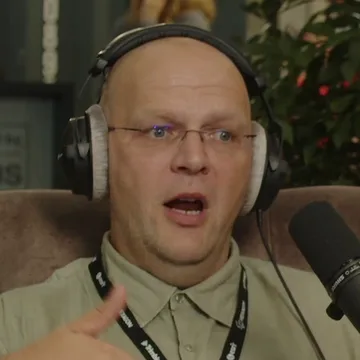
Guest on 2D Is Against My Religion
Josip Rukavina
Vectrino
Josip Rukavina, a civil engineer, works at Vectrino on large-scale and underwater photogrammetry and inspections for ports. Recorded live at INTERGEO 2026, Josip Rukavina explained time shift inspections and why Vectrino adds sound to its digital twins.
In a 90-minute live 2DIAMR session in January 2026, Josip Rukavina explained why a 3D scan is only level zero of a digital twin and why the shallow wave zone is the hardest place for underwater photogrammetry.
Episodes
 21 min
Expo & conference podcast
Underwater photogrammetry and port digital twins – Josip Rukavina, Vectrino
Josip Rukavina · Vectrino
 1 h 30 min
Deep dive
Underwater photogrammetry and port digital twins: why a 3D scan is only level zero – Josip Rukavina, Vectrino
Josip Rukavina · Vectrino
In Josip’s words
“Because so many scanning, and nothing is happening.”
“We went in this direction because it was hard, and we know that competition will not follow easily.”
“We are not just producing the datasets. We are producing you time shift-ready inspections so you can make decision in next three, four, five, seven, 20 years.”
“And then we started to use sound in our digital twins.”
“So you can prepare 45 minutes.”
“When you start to work with the underwater photogrammetry, it is just about portfolio, and you need to understand that buying the equipment won't solve your problem.”
“From the perspective of photogrammetry, you have stable environment at four thousand meters. Nothing is happening. No waves.”
“Our clients are really, really interested in time shift. They are not interested in data gathering, accuracy, precision. This is something on us.”
Quoted in our tech guides
Gaussian splatting vs photogrammetry: what 24 practitioners say →
- “In underwater, we are looking for the cracks.”▶ 44:32
Is a 3D scan a digital twin? What 13 practitioners say →
- “Our clients are really, really interested in time shift. They are not interested in data gathering, accuracy, precision. This is something on us.”▶ 61:14
Questions Josip answered
- What does Vectrino do?
- According to Josip Rukavina, Vectrino does large-scale and underwater photogrammetry and inspections, for example for ports, and sells door to door rather than at trade fair booths. ▶ 5:51
- What is a time shift inspection?
- According to Josip Rukavina, it is a series of inspections overlapped over time: you record what is good, and in the next inspection you see what percentage became bad, so you can decide when to invest. ▶ 4:42
- Why add sound to a digital twin?
- According to Josip Rukavina, people expect it, like seagulls over a port or wind tied to a real wind gauge; it gives the brain more information, and Vectrino's clients liked it. ▶ 10:38
- Can AI predict incidents in a port?
- According to Josip Rukavina, if rain and wind gauge data show the same pressure pattern about 45 minutes before past incidents, a port could stop the cranes, move the ship and bring tugboats in time. ▶ 16:32
- How should AI be used on inspection data?
- According to Josip Rukavina, on points along a defect such as a crack, to fit a curve and predict when it will fail and when investment is needed, not to generate data. ▶ 13:05
- Is a 3D scan of a port a digital twin?
- Not yet, according to Josip Rukavina: the scan is just level zero. A digital twin should let you predict what will happen, using sensors, vessel positions and weather data on top of properly captured real data. ▶ 2:09
- Why do ports need underwater photogrammetry?
- Josip Rukavina says repeated time shift inspections follow cracks, concrete and steel over the years, so port authorities and operators can predict when a structure would fail and how much rehabilitation it needs. ▶ 10:47
- What is the hardest part of underwater photogrammetry?
- According to Josip Rukavina, the shallow wave zone: sunlight on small waves makes “zebra stripes” that differ in every frame. Deep water is stable – the only light is the light you bring. ▶ 27:51
- How murky can the water be for underwater photogrammetry?
- Josip Rukavina puts Vectrino’s limit at about 50 NTU, roughly one meter of visibility; in more turbid water multibeam sonar is the answer, so the method works in only about 40% of the world’s seas. ▶ 38:14
- Who pays for underwater inspections of port structures?
- According to Josip Rukavina, asset owners such as port authorities, and insurance companies that push terminal operators to inspect and often want just the raw 3D data to judge the structure themselves. ▶ 64:29
Talks about
Related guests
- Michael Rubloff – Founder, Radiance Fields
- Arek Szadkowski – Global Lead, ArcGIS Reality, Esri
- Michal Ukropec – CEO, Twinzo
- Rami Tamimi – Geomatics project manager and Ph.D. candidate, WSP
- Olli Huttunen – 3D Gaussian Splatting creator
- Barry Bassnett – Digital twin practitioner, author of Tower of Twins